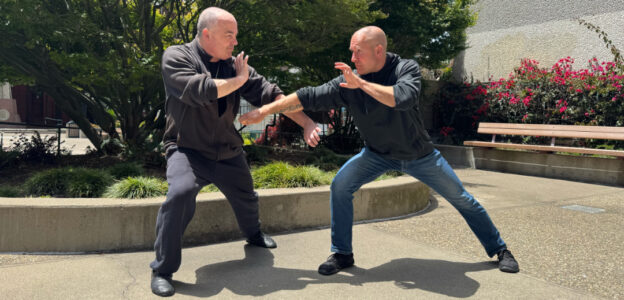
Please check out a PRACTICAL Hung Kyun combat sequence featuring many of the characteristic techniques of our style. The sequence is explained and demonstrated by Michael Goodwin Sifu of the San Francisco Hung Gar Association. Continue reading
![]()
Please check out a PRACTICAL Hung Kyun combat sequence featuring many of the characteristic techniques of our style. The sequence is explained and demonstrated by Michael Goodwin Sifu of the San Francisco Hung Gar Association. Continue reading
![]()
Lam Family Hung Kyun is a living tradition: rooted in the past, practiced in the present, and carried forward into the future.
In this interview, Michael Goodwin Sifu of the San Francisco Hung Gar Association, shares his perspective on preserving the lineage while developing it for the next generation. Continue reading
![]()
Today’s best-known lineage of Hung Kyun comes from Wong Fei Hung. It is sometimes called “New Hung Kyun” (San Hung Kyun). Compared to the “narrow stance, short bridge” of “Old Hung Kyun,” it also features “high stances and long bridges,” originally derived from the famous Sino-Tibetan style Hap Kyun, making it a truly comprehensive style, suitable for both long-range fighting and close-quarter combat. Continue reading
![]()
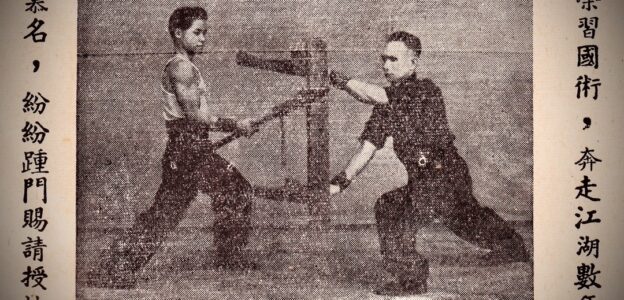
Various Hung Kyun 洪拳 lineages taught various weapon sparring sets, many of which have been lost. The old image above, from the Lam Sai Wing Memorial Book (published in 1951), features Grandmaster Chiu Kao (趙教 Jiu Gaau) and his eldest son, Grandmaster Chiu Wai (趙偉 Jiu Wai), performing Long Bench Versus Big Broadsword (Cheung Dan Deui Daai Dou 長櫈對大刀). Continue reading
![]()
Traditional martial arts have long used specialized tools to develop functional power and strength, such as:
As effective as these tools are, many are difficult to obtain in the West—and even in China today. As a result, many functional martial artists switch to more widely available training tools, such as kettlebells, barbells, and dumbbells. Continue reading
![]()
In many classic Wong Fei Hung films, you’ll spot an “Ancestral Tablet of the White Crane Patriarch” (白鶴先師神位) in Bou Ji Lam (寶芝林醫館). This may not be a mere movie invention. Jyu Yu Jaai (朱愚齋)—disciple of Lam Sai Wing (林世榮) and a noted writer—records in his Biography of Mr. Lau Jaam (劉湛) that Lam’s school kept an altar bearing that inscription.
![]()
Among the renowned “72 Secret Skills of Shaolin” (Siulam Chaat Sap Yi Jyut Gei 少林七十二絕技), one foundational practice stands out for cultivating resilience, power, internal harmony, and strike resistance: „Crouching Tiger Skill“ (Ngo Fu Gung 臥虎功), also called „Taming the Tiger Skill“ (Fuk Fu Gung 伏虎功). Continue reading
![]()
The so-called “Five Forms” (Ng Ying 五形 ) are: Dragon (Lung 龍), Snake (Se 蛇), Tiger (Fu 虎), Leopard ( 豹 Paau), and Crane (鶴 Hok).
The core nature lies in the cultivation of Essence (精 Jing), Strength (Lik 力), Breath/Internal Energy (Hei 氣), Bones (Gwat 骨), and Spirit (San 神). Each form has its unique brilliance, and each method has its distinct function. Continue reading
![]()
The Ng Long’s Eight-Trigram Spear Technique (Ng Long Baat Gwa Cheung Faat 五郎八卦槍法) was transmitted by Lo Mou Hing 羅茂興 of Saichiu 西樵 in Yut 粵 (Gwong Dung). After mastering the art, he studied martial arts at a temple on Ng Toi Saan 五台山 and returned to Gwong Dung to teach. His refined method, influenced by his monastic training, became widely disseminated. Continue reading
![]()
Petr Vrána Sifu and his lovely daughter Berta training under the tutelage of Grandmaster Lam Chun Sing, the son of the legendary Grandmaster Lam Jou. Continue reading
![]()