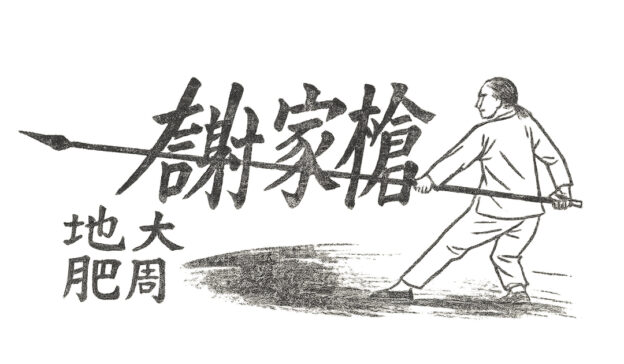
The Ng Long’s Eight-Trigram Spear Technique (Ng Long Baat Gwa Cheung Faat 五郎八卦槍法) was transmitted by Lo Mou Hing 羅茂興 of Saichiu 西樵 in Yut 粵 (Gwong Dung). After mastering the art, he studied martial arts at a temple on Ng Toi Saan 五台山 and returned to Gwong Dung to teach. His refined method, influenced by his monastic training, became widely disseminated. Continue reading →
“Hands are unique weapons in the Chinese martial arts”, says Grandmaster Wai Hong of Tiger Claw System – and his “Tiger Claws” are proof. We will reveal his unique push-up variation in the video below, but first some experience from my lineage and other Masters I met. Continue reading →
Whereas the dragon represents the spirit, the snake represents the Qi (氣), the breath, and circulation of energy within the human body. Sometimes referred to as a “little dragon,” the snake likewise speaks to the covert, and the unseen.
The snake techniques are generally considered to be a bare-hand extrapolation of ancient spear technique, and as such exemplify the principle of, “defend with a circle; counter with a straight line.” The Hung Kyun maxim states, “hard counters the soft; soft controls the hard.” Thus, the snake’s hard bridging is manifest with rooted stance and iron force, heavy as a python’s coils, while it’s elusive twining, soft bridging action is unfelt until striking the vital points, venomous as a cobra’s touch. Continue reading →
This is one of the original forms, and was the first form taught in the Dang Family Hung Ga curriculum. The form is much shorter than Gung Ji Fuk Fu Kyun, comprising of less than one hundred moves.
In the Wong Fei Hung curriculum, three famous sets, the “Gung 工 Character Tiger Subduing Set” (Gung Ji Fuk Fu Kyun 工字伏虎拳), the ““Tiger and Crane Twin Pattern Set”” (Fu Hok Seung Ying Kyun 虎鶴雙形拳), and the “Iron Thread Set” (Tit Sin Kyun 鐵線拳 ), are collectively known as “The Hung Kyun Three Treasures.” However, the “Ten Patterns Boxing Set” (Sap Ying Kyun 十形拳) was originally established by Lam Sai Wing, to revise and consolidate key portions of the curriculum as he had learned it from Wong Fei Hung.Continue reading →
Tit Kiu Saam (“Iron Bridge” Three) was one of the best fighters of 19th century Southern China – one of the legendary “Ten Tigers of Gwong Dung”. He was famous for her “Bridges” (Kiu), firm stances (Ma) and incredible strength, developed thanks to his “Iron Thread Set” (Tit Sin Kyun).
We don’t have much information about his other techniques, but if: Continue reading →
Today I would like to share my thoughts concerning the differences and similarities between Wing Cheun (Yip Jing and Yun Kei Saan lineage) and Hung Kyun (Lam Family lineage). In the first place, please note that it is not the intention of this article to assert whether these excellent arts are superior to one another or to any other styles of martial arts. My intention is to explore the similarities and differences between the two arts so as to expand knowledge and understanding of these arts.
Having trained in Wing Cheun for more than 20 years and Hung Kyun for nearly 10 years, it is quite clear despite some fundamental differences that both of these excellent arts have, they also share a number of similarities. Continue reading →
“Flowery fists, embroidery legs” is a popular Chinese saying, describing a “martial” art that looks good, but has no combat use.
Often this is indeed a truth – and it does not matter if it is modern or traditional style. In many other cases, technique that looks flowery may have a practical combat usage – it was just forgotten. Continue reading →
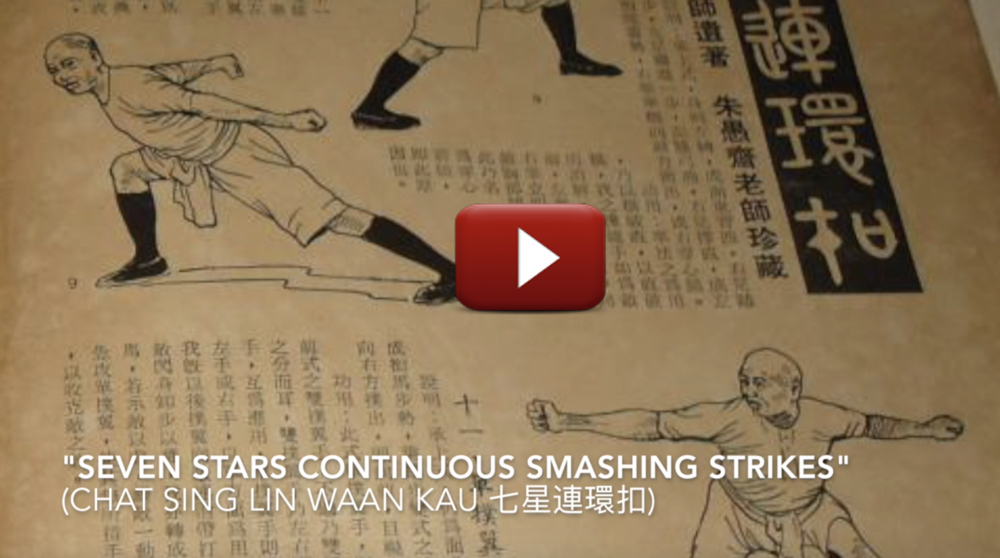
“Long Bridges” techniques in “Tiger Crane Double Form Set” (Fu How Seung Ying Kyun) come from “Buddhist Family Arhat Style/Set” (Fat Ga Lo Hon Kyun) – including the “Seven Stars Continuous Smashing Strikes” (Chat Sing Lin Waan Kau)
Vast majority of “Five Elements” boxing techniques from the “Five Animals and Five Elements Set” (Ng Ying Ng Hang Kyun) are virtually the same as in today’s Hap Kyun
We have a photo of Lam Sai Wing, performing “Wing-Flap Hand” (Pok Yik Sau) technique, which is not found in any today’s Hung Kyun set. The article mentions “Seven Stars Continuous Smashing Strikes” as one of the special methods of Wong Yan Lam’s disciple, Hap Kyun’s Wong Mun Wing (Wong Hon Wing) – read the article here.
…and now, we have acquired a rare article series about Lam Sai Wing’s “Seven Stars Continuous Smashing Strikes [Set?]”, which btw. includes a drawing of the Pok Yik Sau – plus few other typical Hap Kyun techniques!


![“The Five Animal, Five Element Boxing Set” of Hung Kyun Master Lam Sai Wing: Snake Section [Part 2 of 10]](https://practicalhungkyun.com/wp-content/uploads/2020/02/hung-ga-kyun-five-animals-five-elements-snake-form.jpg)
![“The Five Animal, Five Element” aka “Ten Forms“ Boxing Set of Hung Kyun Master Lam Sai Wing: Intro & Dragon Section [Part 1 of 10]](https://practicalhungkyun.com/wp-content/uploads/2019/11/hung-ga-kyun-five-animals-five-elements-michael-goodwin-dragon.jpg)