“Six and Half Point Long Pole” (Luk Dim Bun Gwan) is one of the most famous weapon techniques of Southern Chinese martial arts. It is practiced both in “old Wing Chun ” and modern (Fat Saan) Wing Chun.
“Six and Half Point” was also a part of Lam Sai Wing’s Hung Ga Kyun curriculum. Grand Master Lam Jou writtes:
My uncle, Lam Sai Wing, added “Six and Half Pole” Techniques to this. The “Six and Half Pole” techniques were famous among the Chinese opera groups. These techniques originated from the Siu Lam monastery and then spread among the Chinese opera groups.
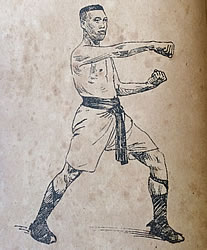
Question: “Old Hung Kyun”, also called “Village Hung Kyun”, vs. today’s most widely spread lineage of Grand Master Wong Fei Hung.
Can you please summarizes their brief history, connections, development and techniques of the “Old Hung Ga” and “Modern Hung Ga”?
Answer: This month’s Hung Kyun question wasn’t raised by a single individual, but actually by many of you. I have received many quests regarding the “Old Hung Kyun” as a response to our regular Practical Hung Kyun Newsletter, on Facebook, as well as various discussion forums.
Please check out the brief analysis and comparison between old and new Hung Ga Kyun, their connections, development, techniques and fighting strategy below!Continue reading →
Our Practical Hung Kyun training philosophy has many different influences, no surprise, not all of them are Hung Ga Kyun.
In this post i would like to give credit to one of our brother arts, three Davids, and recommend an excellent book which just have been published. On the shoulders of giants, indeed….
My Si Hing Michael Goodwin from San Francisco told me long time ago: “If you want to understand our Long Bridges techniques, you have to study some Tibetan White Crane, Lama Paai or Hap Ga”. When my Si Hing says something, I take notes – I followed his advice and have tried to find as much information about these so called Tibetan styles as possible. Continue reading →
Hung Ga’s “Four Secret Arrivals”, as transmitted by the late Grand Master Lam Sai Wing. Final number four, i.e. “Feet Arrival” (Geuk Dou).
As we saw in the 3rd installment, the third “Arrival” were “Hands” (Sau Dou). At first I thought – maybe the order is wrong: I should first step to be close enough to hit him, and then hit him. But then it hit me (pun intended) – no… not really!
Of course the Juk Dou is about correct distance, but the order of the “Four Arrivals” (Sei Dou) IS significant. Continue reading →
Question: Hello Sifu, thank you for the excellent information you are sharing at Practical Hung Kyun blog. I am studying Hung Gar Kung Fu for more almost ten years, but I must to say that your approach completely changed my approach to the art, its training and application. In last few months, I have progressed faster than in last few years. I am doing less stuff, but better, as you have suggested.
I have heard my instructor to talk about so called Twelve Bridges, but when I asked for more information, I unfortunately did not get any. I was told that it was lost and secret art….
I have noticed that you have mentioned Twelve Bridges on various occasions. Can you please briefly summarize the theory behind Twelve Bridges of Hung Gar?
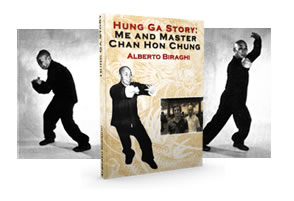
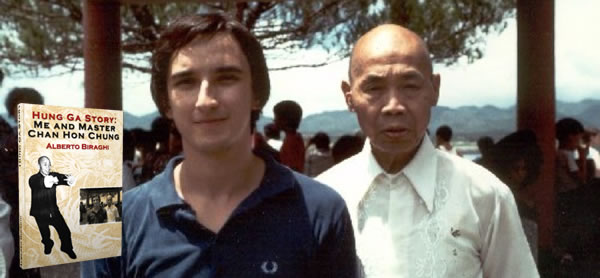
Hung Ga Story: Me and Master Chan Hon Chung: exclusive excerpt from Alberto Biraghi’s excellent book!
Hung Ga Story is a memoir of Alberto Biraghi and his martial arts journey.
Alberto studied the traditional Hung Ga Kyun in Hong Kong with the late Grand Master Chan Hon Chung, spending with him more than a month per year from 1977 until the closing of his historic gym at 729 of Nathan Road.
Are you curious about traditional Gung Fu training in Hong Kong in 1970’s and 1980’s? Well, read on!
Learning the Hung style was not easy in 1977, especially if you were Italian.
I knew nothing about Gung Fu apart from what I saw in a few movies, neither did I know about Chinese culture. In these miserable condition I entered a temple of knowledge and tradition and to make it worse, Benjamin Fung introduced me as “an Italian karate expert who wants to checkout Chinese Gung Fu”. As you can understand the first welcome was kind of cold and suspicious (I didn’t realize it immediately, I was told a month later by the students, after friendship had been established, that no presentation could have been worse in that community). Continue reading →
Question: Sifu, I have a question. I have found out that Wong Fei Hung used an umbrella as a weapon.
Do you know any form and application of an umbrella, or is lost?
Thank you!
Andrea C.
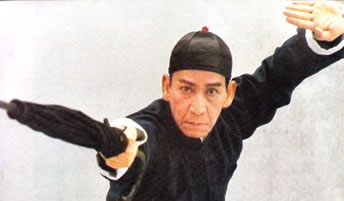
Answer: According to historical accounts, an umbrella was actually one of the favorite weapons of Wong Kei Ying, Wong Fei Hung’s father, not Wong Fei Hung. Please see an entertaining video below, from a legendary movie Iron Monkey.
Wong Kei Ying is played by Donnie Yen, and gives a nice show of an umbrella fighting. Continue reading →


 Question: “Old Hung Kyun”, also called “Village Hung Kyun”, vs. today’s most widely spread lineage of Grand Master Wong Fei Hung.

 “Iron Wire Set” (Tit Sin Kyun), one of the “Three Treasures”, secret and most advanced internal set of Hung Kyun’s curriculum.
 Question: Sifu, I have a question. I have found out that Wong Fei Hung used an umbrella as a weapon.