Hung Ga Kyun sets, techniques, applications, weapons, legends and stories…
Do you wonder – are there any “secrets”?
Well, find out!
Get the top information from reliable source & read the special vintage Hung Ga Kyun articles collection from the legendary Hong Kong Secrets of Kung Fu magazine!
Question: Sifu, everybody says that Hung Ga should be practiced in very low stances. I have noticed that you are sometimes using higher stances, sometimes lower stances – but still a bit higher than I usually see. Can you explain why?
Karl S.
Answer: Hung Ga = low stances, period. Right?
Right?
„Low stance, low stance!“, the Hung Ga Sifus shout out loud all over the world. „Don’t be lazy!“ Pain is good.
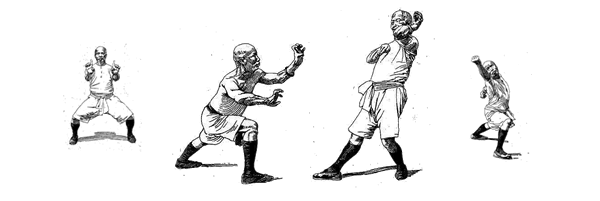
Well, stance training might serve as leg strengthening in the beginning phases of your Hung Ga journey, but the true aim of “Stances” (“Horse” in Chinese, Ma – take a hint why!) is different: Structure, body mechanics and power generation.
When I was studying Hung Kyun in San Francisco under the guidance of Y.C. Wong Sifu in 1997 with my classmate Aleš, we used to walk from the train station to the Chinatown, for about half an hour.
On our way to the Mou Gwun there was a bookshop, with quite a few interesting martial arts books. We used to stop by and stay in the bookshop for a while, reading some them – we did not have a job at that time, and enough money for the fees, train and food, so we couldn’t buy any. All we did was practice and practice.
Out of the many books, I have found out one that was especially very interesting – it was written by Malaysian Southern Siu Lam Grand Master Wong Kiew Kit – Introduction to Shaolin Kung Fu. Interesting stuff happened – whatever I read about in the book in the afternoon, I have learned it in my Gung Fu lessons in the evening, be it technique, concept or fighting strategy! Was it a coincidence? I have decided to skip some meals so I can buy this interesting book. Continue reading →
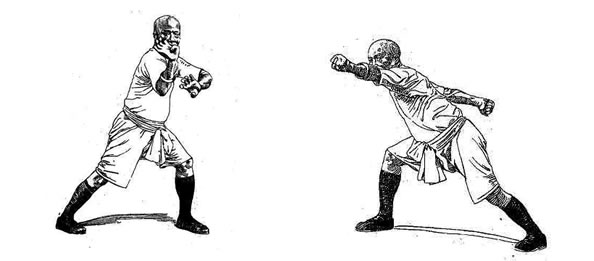
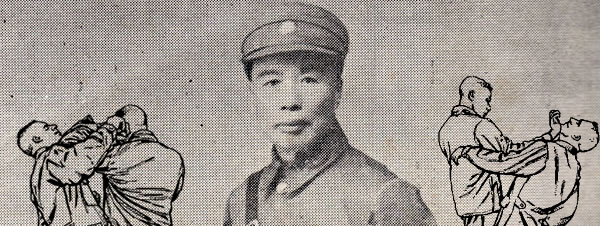
Check out one of the traditional Southern Chinese martial arts wrestling techniques, “Double Dragons Embrace the Moon” (Seung Lung Bou Yut).
The drawing and the original text comes from an old boxing manual titled The Essence of Boxing Art (Kyun Seut Jing Wa) from my collection of old books.
“Fu Hok Seung Ying Kyun is one of the methods of our martial arts style. This set was created by the late Grand Master Wong Fei Hung. When he was a child, he made an itinerant living as a street performer together with his father, Great Grand Master [Wong Kei Ying].
In his prime, we worked as a coach of Lau’s and Ng’s army. He became very famous and has met many other excellent Masters. He picked up the the essential techniques of various famous styles, has mastered them through a comprehensive study, transformed them and created Fu Hok Seung Ying Kyun.”
Hung Ga Insider Forum was founded as a non-political community platform – place where all the Hung Ga Kyun practitioners from every school, branch and lineage can come together and exchange their information and ideas on all aspects of our beloved art!
Question: I have heard that Grand Master Lam Sai Wing has taught in the army. Is it true? Can you please give some examples of simple Hung Gar bare-hand combat techniques that could be used in an unarmed combat situation in the army or on the street today?
Harvey H.
Answer: It is well documented that Wong Fei Hung, Lam Sai Wing (and various other Hung Ga Kyun Masters) taught martial arts in the army.
Wong Fei Hung served his duty under famous army commanders Lau Wing Fuk, Ng Chyun Mei, Tong Ging Sung, Lam Sai Wing under Lei Fuk Lam, and Chan Jai Tong. (You can find out more in the intro parts of Lam Sai Wing Memorial Book and Lam Sai Wing’s Taming the Tiger Manual).
Their function wasn’t only honorary. We can only guess what specifically they taught in the army. Still, we know that both Wong Fei Hung and Lam Sai Wing taught actual combat techniques – not only strength/conditioning drills to keep the soldiers disciplined and fit, but also weapon and bare-handed combat skills. Moreover, they taught and learned from the other Masters and cross-trained.
Hung Ga Grand Master Ho Lap Tin, one of the most senor disciples of Grand Master Dang Fong, dedicated a short paragraph to Grand Master Lam Sai Wing in his book “Hung Kyun Application Drills” (Hung Kyun Saan Sau) .
Here is the translation and scan of the original version:
Lam Sai Wing has specialised in Hung Kyun: „Five Animals Set“ (Ng Ying Kyun), „Taming of the Tiger in Gung Pattern“ (Gung Ji Fuk Fu Kyun), „Iron Thread Set“ (Tit Sin Kyun), „Five Elements Set“ (Ng Hang Kyun), all passed from Wong Feihung. Furthemore he has intensively studied one set – „Tiger and Crane Double Form“ (Fu Hok Seung Ying Kyun). Continue reading →
Question: Sifu Macek, can you please briefly explain the “Twelve Bridge Hands” of Hung Ga Kuen? As your school is called Practical Hung Kyun, I would appreciate some practical examples of how to use the “Twelve Bridges” in training or a real fight.
Jorge C.
Answer: First two Bridges – Hard, Soft (Gong, Yau) and the last two Bridges – Control, Adapt (Jai, Ding) are a general Yam/Yeung (Yin/Yang) framework of the remaining eight. We at Practical Hung Kyun want to end up the confrontation as fast as possible, using hard power and total control. If we meet a stronger opponent, we use soft power and adapt to the opponent’s action.
I took your question as a challenge, and tried to explain the “Twelve Bridge Hands” of Hung Ga in twelve lines/paragraphs. Continue reading →
 Hung Ga Kyun sets, techniques, applications, weapons, legends and stories…
 When I was studying Hung Kyun in San Francisco under the guidance of Y.C. Wong Sifu in 1997 with my classmate Aleš, we used to walk from the train station to the Chinatown, for about half an hour.

 Hung Ga Grand Master Ho Lap Tin, one of the most senor disciples of Grand Master Dang Fong, dedicated a short paragraph to Grand Master Lam Sai Wing in his book “Hung Kyun Application Drills” (Hung Kyun Saan Sau) .