While being a youngster doing martial arts of course I did a lot of stretching. Mostly it was ‘relax stretching’. I never was really flexible, but then again, it wasn’t really needed for Kempo and traditional Kungfu. Dynamically I could kick about the height of my head, and that was enough. Continue reading →
Everyone says that Hung style, Lau style, Choi style, Lei style and Mok style are five famous styles in Southern Chinese martial arts. Among these, the Hung style has the most disciples. In the past fifty or sixty years, the Hung style exponents such as Wong Fei Hung, Lam Sai Wing, Taam Man and others have become famous among younger practitioners in Southern China. Continue reading →
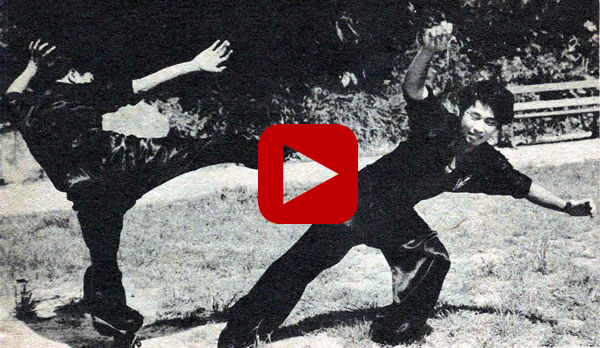
Powerful strikes and blocks, lightning fast kicks, eye-catching sweeps and jumps – this is the most popular modern Hung Kyun sparring set called “Tiger and Crane Double Form Sparring Set” (Fu Hok Seung Ying Deui Chaak), also called Fu Hok Deui Chaak or just simply Fu Hok Chaak.
“Tiger and Crane Sparring Set” is actually not a new set, bud modification of old Lam Sai Wing’s “Taming the Tiger in Gung Pattern Sparring Set” (Gung Ji Fuk Fu Deui Chaak). It was developed by Grand Master Lam Jou, probably in late 1930’s or in 1940’s. “Tiger and Crane Sparring Set” blends traditional Hung Kyun training methods, such as “Bridge Hands” (Kiu Sau) sensitivity and conditioning, practical application, and performance. Continue reading →
Does Hung Ga Kyun have a Wooden Dummy (Muk Yan Jong)? The answer is – it depends.
We have already revealed a traditional Hung Ga Kyun Wooden Dummy in one of our previous articles… kind of, so our regular readers already know.
Let us expand the answer: If a Hung Ga practitioner uses whatever Wooden Dummy, it becomes Hung Kyun Muk Yan Jong. Folks, it is a tool, and if used correctly, it might be very useful tool, not only to condition your palms, fists, and “Bridge Hands” (Kiu Sau). Continue reading →
Answers to the important questions that every martial artist should ask!
The second part of our installment got even more positive response than the first one – just wow.
I had to spend literally hours responding to all your emails. Scholars and warriors, thank you, I am very happy you found the practical examples and the short instructional videos useful, even though it is just a tip of proverbial (PHK curriculum) iceberg. Continue reading →
3 aspects, 3 tips, 3 instructional videos with drills that you can immediately add to your training and became healthier, stronger, and more combat efficient.
Welcome in the second part of our installment!
Thank you for all the emails and messages (and even phone calls!) – we at PHK Headquarters got lots of positive feedback and interesting ideas, and even more questions.
I have been training Chinese martial arts since 1991, age 14. I have been most fortunate to study under the guidance of some of the best teachers of Hung Ga Kyun and other various styles in Europe, USA, and of course in Hong Kong and China.
During those years, I have learned all lot of stuff – and I mean a lot of. Techniques, sets, weapons, applications, strength and conditioning exercise, you name it. My teaching methodology and of course my own practice has evolved a lot – if I look back, I can’t help smiling to myself what and how we have practiced. Back in the old days, we were training hard, no doubt about that – and basically every day, couple of hours every day. Why not – we had all the time in the world. Continue reading →
I have been in contact with Charris since late 1990’s. We were both enthusiastic about Hung Ga Kyun training and research, and finally met in 2000 in Germany.
Charris is one of the most senior European students of my Si Baak, Grand Master Lam Chun Fai, so whenever I see him again, I make sure to train with him and learn more about the way my Si Baak does things and teaches. Continue reading →
„Ten Forms Set“ (Sap Ying Kyun) aka „Five Animals and Five Elements“ (Ng Ying Ng Hang Kyun) belongs to the advanced sets of Hung Ga Kyun.
“Five Animals” part comes for the (pre-)Wong Fei Hung era, “Five Elements” section was choreographed by Grandmaster Lam Sai Wing. Various old sources suggest that „Five Animals“ and „Five Elements“ were in the past 2 sets (or more probably series of techniques and combinations), which were joined together and re-choreographed. Continue reading →
Grandmaster Lam Chun Fai has started writing his 3rd Hung Kyun book on “Iron Wire Fist” (Tid Sin Kyun). The targeted release date of this book will be announced in the fall. The Tid Sin Kyun is an advanced level set and it is not usually taught until the practitioner has many years of experience in Hung Kyun training. Continue reading →