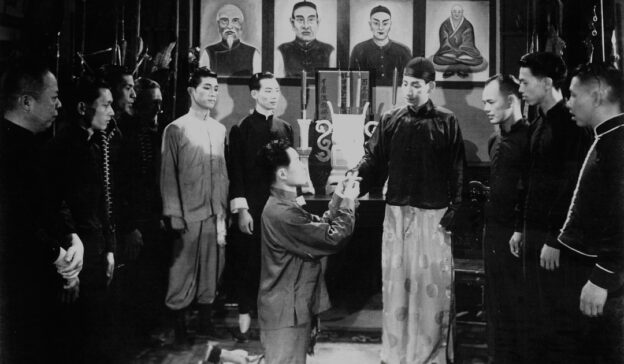
In many classic Wong Fei Hung films, you’ll spot an “Ancestral Tablet of the White Crane Patriarch” (白鶴先師神位) in Bou Ji Lam (寶芝林醫館). This may not be a mere movie invention. Jyu Yu Jaai (朱愚齋)—disciple of Lam Sai Wing (林世榮) and a noted writer—records in his Biography of Mr. Lau Jaam (劉湛) that Lam’s school kept an altar bearing that inscription.
Who exactly the “White Crane Patriarch” was—sometimes styled “Zen Master White Crane” (白鶴禪師) or “Immortal Master White Crane” (白鶴仙師)—is a larger topic we’ll tackle in a future article; we’ve already discussed one hypothesis in this article. Here, let’s focus on the paired couplet that captures the Wong family’s ethic of transmitting the art to posterity. These two vertical tablets flank the altar, left and right:
「百忍前傳仙武術」
「千磨後教佛功夫」
Translation
After enduring a hundred forbearances, transmit the transcendent martial methods;
After a thousand temperings, teach the Buddhist Gung fu.
Line-by-line (segmented)
1. 百忍|前|傳|仙武術
“With a hundred acts of forbearance beforehand, transmit the ‘transcendent/immortal martial methods’.”
2. 千磨|後|教|佛功夫
“Only after a thousand ‘grindings’ (ordeals), teach the ‘Buddhist Gung Fu’.”
Notes
• 百忍 (baak yan) — Literally “a hundred endurances/forbearances.” A set phrase evoking deliberate patience and self-restraint: endure insult and hardship before acting or judging.
• 千磨 (chin mo) — “A thousand grindings,” a classical trope for being tempered by countless ordeals; compare idioms like “[undergo] a thousand grindings and a hundred breakings.” (千磨百折) or “[tempered by] a thousand hammerings and a hundred refinings” (千錘百煉) that stress forging through repeated trials.
• 仙武術 (sin mou seut) — Literally “immortal/transcendent martial methods.” Here, 仙 suggests something numinous/supreme—martial skill refined to an extraordinary level—rather than naming a specific sect. It may also allude to the White Crane Immortal tradition—but the couplet itself speaks to the quality of attainment more than to institutional identity.
• 佛功夫 (fat gung fu) — “Buddhist Gung Fu,” likely pointing to Siu Lam (Shaolin) roots, and/or to Fat Ga/Hap Ga influences associated with the Wong Fe Hung lineage. Both readings are plausible in context.
• 傳/教 (chyun/gaau) — “Transmit/Teach.” In lineage culture, 傳 marks the handing-down of an art; 教 is instruction. The antithesis 前/後 (“before/after”) encodes an ethic: qualification through endurance and tempering precedes the right to transmit and teach.
The even positions and the level/oblique tones of the rhyme match each other perfectly; the diction is extremely well-balanced, showing that the author was a person of considerable learning.
The basic meaning is: “Only after hundreds of endurances and thousands of grindings—bitter training—did I, Wong Fei Hung, attain a state of marvelous skill; therefore, I dare transmit this art to later generations.”
If you enjoy the videos and would like to support our work, please add your comment, click “tweet”, or “like”. Your support will help us publish and share more articles and videos in the future!
Thank you for every visit, “tweet,” “like,” or comment!
-
Chinese Martial Arts: The Secrets of the Old Grandmasters
$9,95 Add to cart -
Sale!
PHK Intro Kit: Beginner’s Guide to Chinese Martial Arts
Original price was: $149,00.$79,00Current price is: $79,00. Add to cart -

Chan Hon Chung Sifu – “Moon Shadow Hand & Kick Poster
$9,95 Add to cart -

Chan Hon Chung’s Tiger and Crane Double Form Set Manual
$19,95 Add to cart
