At the beginning of the twenty-first century, films such as Ip Man and The Grandmaster not only allowed audiences to experience the allure of martial-arts culture, but also inspired deeper reflection on the future of the martial arts. In an age of peace, their glory and transmission have moved beyond “fighting” and returned to their original purpose: “Cultivate virtue through the martial arts; in cultivating martial virtue, propriety comes first” (以武修德,武德修養以禮為先).
In Guangdong (廣東; Gwong Dung), martial arts (武術; Mou Seut) are also known as Gung Fu (功夫). To “practice Gung Fu” (打功夫; da Gung Fu) is simply to study the martial arts.
Frail and frequently ill as a child, I was sent by my father to the martial-arts school (武館; mou gun) of Master Lam Jou (林祖師傅) in Wan Chai (灣仔), where I formally entered his tutelage.
Seeing how slight I was, Master Lam took pity on me. Rather than have me endure the daily journey from Yau Ma Tei (油麻地) in Kowloon (九龍), he introduced me to Master Wong Lei (黃利師傅), a fellow member of his lineage who taught in Mong Kok (旺角), and I became Master Wong’s student.
Every afternoon, I trained at his second-floor school on Portland Street (砵蘭街). Over time, I worked my way through virtually the entire Hung Kyun (洪拳) syllabus taught by Master Wong, as well as weapon forms involving paired butterfly swords (蝴蝶雙刀; wu dip seung dou), the spear (槍; cheung), staff (棍; gwan), sword (劍; gim), whip (鞭; bin), and other weapons.
Because I was still young and short, three forms were considered unsuitable for me: Iron Thread Fist (鐵線拳; Tit Sin Kyun), the Spring-and-Autumn Great Halberd (春秋大關刀; Cheun Chau Daai Gwaan Dou), and the three-section staff (三節棍; Saam Jit Gwan). Apart from these, the various movements and transformations of external training (外功; Ngoi Gung) came readily enough to me.
Yet, as Master Wong observed, I was merely performing the movements of the techniques. My power (勁; Ging) had not been properly developed or expressed. What I possessed remained at the level of the instrument (器; Hei), far removed from the level of true art (術; Seut).
The practice of boxing requires the integration of essence, vital energy and spirit (精氣神; Jing Hei San) with the hands, eyes, body, technique and footwork (手、眼、身、法、步; Sau, Ngaan, San, Faat, Bou). One’s movements must not only be crisp, decisive and commanding, but must also carry concentrated force and exceptional speed: the strike must be delivered in an instant, and the fist or leg withdrawn just as swiftly.
In those days, however, I was still far too slight.
Mainland Lineage Masters Bring Their Martial Arts to Hong Kong
By the time I was thirteen, I had entered secondary school. My studies became demanding, and I could no longer attend the martial-arts school every day.
When I went to bid Master Wong farewell, he repeatedly admonished me: “Never tell anyone that you know Gung Fu.”
I have faithfully observed my master’s instruction ever since.
During the 1940s and 1950s, lineage holders from a wide range of mainland martial-arts traditions moved to Hong Kong. Among them were Hung Kyun masters Lam Sai Wing (林世榮) and Lam Jou (林祖); Wing Chun (詠春) masters Yip Man (葉問) and Dang Yik (鄧奕); and Southern Praying Mantis (南螳螂) master Yip Seui (葉瑞).
They established martial-arts schools in ageing buildings—in crowded urban tenements, on rooftops and inside workers’ clubs. There they taught martial arts while also practising traditional Dit Da medicine (跌打) for sprains, fractures and other traumatic injuries.
Their teaching helped young people become physically stronger and build confidence, self-defense skills, and self-reliance. It taught them to protect themselves and others while ensuring that the martial traditions of their respective lineages would be passed on. The public, especially the younger generation, warmly embraced these schools, and they became part of everyday life in Hong Kong.
Around 1970, Hong Kong reportedly had more martial-arts schools than rice shops. Their number reached 418, with more than 10,000 practitioners.
Outside, traffic streamed past amid the bustle and prosperity of the city. Inside, blades flashed, swords cast their shadows, and fists and feet crossed. Masters versed in the “eighteen kinds of martial skill” (十八般武藝 sap baat bun mou ngai) took turns demonstrating their arts and instructing their students. The atmosphere could hardly have been livelier.
Many students worked during the day to earn a living. When they finished work in the evening, they would buy groceries and take them to the school to prepare dinner. Afterwards, they trained with their masters until midnight. The master’s wife would cook an enormous pot of plain congee as a late-night meal, and only after everyone had eaten would they disperse and return home.
This was the origin of the Cantonese expression “to eat late-night congee” (食夜粥 sik ye juk), meaning to train in boxing or study Gung Fu.
[…]
The Martial Artist’s Highest Realm
While talking with an old classmate, I raised the question of the highest realm attainable by a martial artist.
My classmate had practised both Aikido and Kendo, disciplines through which force of will is transformed into martial power.
If there is man fa—culture or “civil transformation” (文化)—might there also be mou fa, or “martial transformation” (武化)? Or, when the two are pursued to their ultimate conclusion, do the civil and martial become one and return to a common source?
We may go further still, using the five concepts found in traditional Chinese culture—Way, virtue, method, art and instrument (道、德、法、術、器; Dou, Dak, Faat, Seut, Hei)—to understand the different levels and dimensions of martial learning.
The instrument (器; Hei) encompasses tools, weapons, fists and feet, and the physical vehicles through which the martial arts are expressed.
The art (術; Seut) encompasses skills, techniques, tactics and experience.
Method or principle (法; Faat) encompasses methods, strategies, objectives, ideas and overall strategy.
Virtue (德; Dak) encompasses values, vision, inner confidence and ideals.
The Way (道; Dou) is one’s mission, original purpose, guiding philosophy and essential nature.
Those entering combat tend to concern themselves with instrument, art and method. Yet it is martial virtue (武德; Mou Dak) that commands respect, while the Way of the martial artist (武者之道; Mou Je Ji Dou) is what ultimately overcomes an opponent.
Before one can defeat others, one must first overcome oneself. Only by relinquishing the self (無我; Mou Ngo) can one prevail from an altogether higher plane. This is the source of invincibility.
My old classmate thought this was too abstract and beyond the understanding of the ordinary martial-arts practitioner. Better, he suggested, to express the insight in a single sentence.
Gung Fu is ultimately a combination of three things: method, practice and time.
One follows the method taught by one’s master and puts it into practice—training, and then training again. Through the expenditure of sweat, blood and time, one eventually brings the endeavour to fruition.
This is only a guide to learning how to endure hardship. There are further insights to be attained at each stage.
Uninterrupted, arduous practice requires freedom from distraction and separation from the outside world. One devotes oneself entirely to repeating a single task until it is performed correctly. One abandons illusion and returns to truth, resting serenely in non-action while allowing the vital spirit to act—just as Heaven and Earth accomplish their work without deliberate action.
Only then can the true self appear, enabling the practitioner to enter the realm of unity between Heaven and humanity (天人合一; Tin Yan Hap Yat).
Gung Fu is both an art of action and a discipline through which the mind and will are cultivated. Martial attainment (武功; Mou Gung) embraces energy work (氣功; Hei Gung), internal training (內功; Noi Gung), cultivation of the Way (道功; Dou Gung), and meditative or Zen cultivation (禪功; Sim Gung).
To practise martial arts is to train one’s essence, vital energy and spirit. It is to cultivate the heart and mind (修心; Sau Sam) and return to one’s inherent nature (自性; Ji Sing).
I am reminded of an autumn day in 2006, when I officiated at the consecration of a temple in the New Territories. Another guest, Lawyer Yung (翁律師), approached to greet me together with Master Lau (劉師傅), a martial-arts director.
Master Lau’s voice arrived before he did. From a considerable distance, he shouted, “I hear you know Gung Fu too!”
He then charged forwards with an arrow step and drove a fist directly towards the middle burner (中焦; Jung Jiu) in my abdomen.
Startled, I instinctively turned my body and shifted half a step backwards. My left hand rose to protect my face as my right hand pushed his fist aside.
But Master Lau had only been feinting. Just as our fists were about to collide, he abruptly withdrew the technique and sprang away. He then turned back, embraced me and laughed heartily.
“Guard the centre gate and protect the upper line. Four taels can deflect a thousand catties; neutralise and strike in the same movement (守中門,護上路,四兩撥千斤,連消帶打; sau jung mun, wu seung lou, sei leung but chin gan, lin siu daai da). You truly are a worthy brother of the same school!”
I stood frozen, not daring to move, while Lawyer Yung doubled over with laughter.
As we chatted afterwards, I learned that Master Lau had also studied under Master Lam in Wan Chai.
That instinctive response—at once conscious, spontaneous, self-propelled and automatic—showed that the ceaseless energy of Gung Fu had long since penetrated every cell of my body. This was another kind of realisation.
The day before yesterday, I visited my hundred-year-old mother. For more than seventy years, she has practised Taijiquan (太極拳; Taai Gik Kyun) every day.
Her steps were now unsteady, but I watched as she lowered herself into a horse stance (馬步 Ma Bou) and moved through Cloud Hands (雲手 Wan Sau), seemingly with and without conscious intention.
A profound sadness arose within me.
Non-action, no-self and non-abiding (無為、無我、無住; mou wai, mou ngo, mou jyu)—what, ultimately, makes Gung Fu?
“Use no method as method; take the absence of limitation as limitation” (以無法為有法,以無限為有限; yi mou faat wai yau faat, yi mou haan wai yau haan).
For a single instant, time and space seemed to converge. I felt that I, too, had caught a glimpse of another realm of Gung Fu.
- Chinese original: 功夫 不只是功夫, by Hoh Ji Ping (何志平), originally published in Ta Kung Pao (《大公報》), abridged.
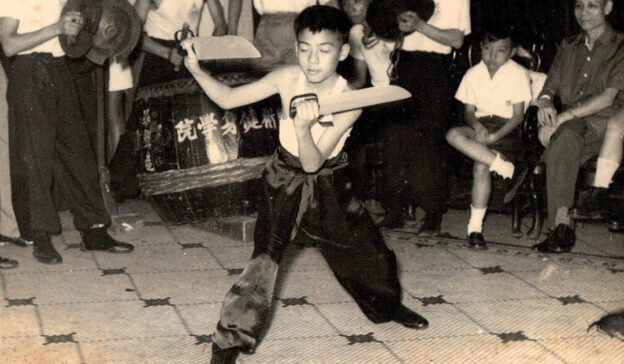
- Image: The author at the age of 10, wielding a pair of Butterfly Knives.
If you enjoy the videos and would like to support our work, please add your comment, click “tweet”, or “like”. Your support will help us publish and share more articles and videos in the future!
Thank you for every visit, “tweet,” “like,” or comment!
-
Chinese Martial Arts: The Secrets of the Old Grandmasters
$9,95 Add to cart -
Sale!
PHK Intro Kit: Beginner’s Guide to Chinese Martial Arts
Original price was: $149,00.$79,00Current price is: $79,00. Add to cart -

Chan Hon Chung Sifu – “Moon Shadow Hand & Kick Poster
$9,95 Add to cart -

Chan Hon Chung’s Tiger and Crane Double Form Set Manual
$19,95 Add to cart